Discovery Is Being Industrialized. Trial Execution Is Not.
If we had a LinkedIn follower for every new AI-powered drug discovery company we come across... Last week, Anthropic revealed Claude Science, an AI workbench for scientists, setting off another round of discussion around frontier labs' role in the future of AI drug discovery.
The excitement is earned. AI really can accelerate discovery, and that's exactly where the frontier labs are focused.
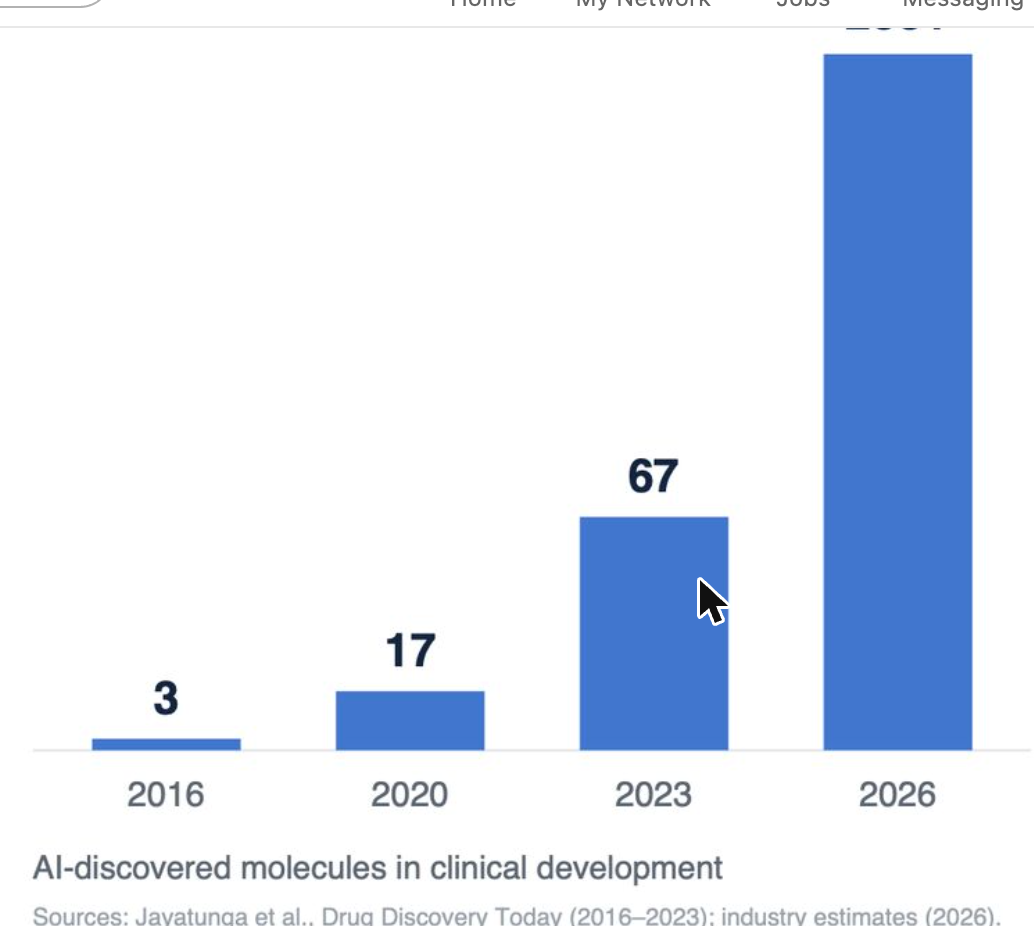
The number of AI-discovered molecules entering clinical development has gone from 3 in 2016, to 17 in 2020, to 67 in 2023, to an estimated 200+ in 2026.
But every one of those molecules still has to run through a clinical trial
That means finding the right sites and patients, and navigating the administrative and compliance workflows that sit across a fragmented stack of systems. Better models don't solve those problems.
The people running large pharma know it. Novartis CEO Vas Narasimhan, who also sits on Anthropic's board, attributes roughly 40% of drug-development time to just two things: missing information and the difficulty of running operations. Both are execution problems, not discovery problems — and both are addressable with purpose-built AI workflows and process.
The majors are already capturing those gains. Bristol Myers Squibb CEO Chris Boerner has described generating thousands of use cases with at least a 5–10% productivity lift across the organization. At that scale, that kind of operational return compounds fast.
The catch
Big pharma has the people and budgets to build purpose-built tooling for its own operations. The nimble companies — the lean sponsors and sites doing more with less — don't. They're left running the same fragmented, manual workflows with fewer people, while the majors pull further ahead on exactly the layer where the time and money are hiding.
Our mission is to level the playing field for those organizations.
Discovery is being industrialized. Trial execution is not.